Low Maintenance Decking Options Composite vs. Wood and More
By
Avery Chua
Posted on
Friday, March 27, 2026 3:44 AM
Low-Maintenance Decking Options for a Hassle-Free Backyard
What this article will tell you:
- What is a low-maintenance decking material
- A comparison between composite decking and capped composite decking
- The benefits of aluminum decking, and which type of decking projects are best suited for this decking option
- Tropical hardwoods like teak and ipe wood are low-maintenance decking material products, but with a higher cost
- The bamboo option: it’s more affordable than tropical hardwoods, but almost as maintenance-free as composite and capped composite decking
The best decking option is one that makes your yard look stunning years after installation. But the look of wood on outdoor living spaces wears off quickly. Regarding maintenance, it’s even more pronounced in commercial areas, where maintaining your deck can become an annual expense.
Architects, engineers, contractors, and homeowners consider maintenance requirements before deciding on the best decking material. The rule of thumb is that the more expensive the initial investment, the less maintenance will be required further down the line.
So, let’s dive into the best deck material options on low-maintenance products available today. We will assess each material's true long-term commitment to help contractors pick the right decking material for their project.
What Is "Low Maintenance" in Practical Terms?
When it comes to decking, the term low-maintenance gets applied liberally in marketing materials, but there are specific practical aspects that matter and make a difference.
Minimal Cleaning Requirements
Truly low-maintenance materials require only periodic cleaning with water and mild soap, rather than specialized cleaning products or power-washing schedules.
No Sealing or Staining
Low-maintenance materials don’t need protective coatings or refinishing, which are time-consuming and costly maintenance chores.
Resistance to Common Damage
The most low-maintenance decking material displays resistance to fading, staining, scratching, splintering, and warping. It requires very few, if any, repairs over the deck's lifespan.
Longevity Without Replacement
A long material lifespan without board replacement or structural repairs reduces maintenance costs and disruption.
Mold and Mildew Resistance
Materials that are naturally resistant to biological growth reduce the need for treatments and any health concerns.
Composite Decking: The Low-Maintenance Deck Standard
Composite materials have become virtually synonymous with low-maintenance decking. They combine wood fibers with plastic polymers to create engineered products with very low maintenance requirements.
Maintenance Profile
Composite decking requires periodic cleaning to remove dirt, debris, and organic material. Most manufacturers recommend cleaning two to three times annually with soap and water. Unlike wood, composites never require sanding, sealing, staining, or refinishing. There are no splinters, and the material resists the cracking and splitting that plague natural wood.
Performance Reality
First-generation composites experienced issues with fading, staining, and mold growth, tarnishing the category's reputation. Modern formulations have addressed many of these issues, and many manufacturers now offer 25-30-year warranties for structural integrity and resistance to fading and staining.
Performance depends on quality and price. Budget composites can exhibit noticeable fading in intense UV environments and weather conditions, while premium products maintain their rich brown color remarkably well.
Surface scratches are the biggest challenge for composites. Unlike wood that can be sanded and refinished, scratches on composite boards stay there forever. Heavy-foot-traffic areas and homes with pets may show wear patterns over time.
The plastic content also means composites retain heat in direct sunlight, which can be uncomfortable during the summer months.
Ideal Candidates
Composite decking is ideal for clients who want convenience and predictable long-term costs over natural looks. The material works particularly well for:
- Vacation homes or rental properties where owners want minimal involvement.
- Busy families who can't dedicate time to deck maintenance.
- Commercial installations that require a consistent look with limited maintenance budgets.
Capped Composite and PVC Decking: Premium Low Maintenance Performance
Advanced synthetic materials featuring polymer caps over composite cores or solid PVC construction are the current pinnacle of low-maintenance deck technology.
Maintenance Profile
These materials deliver on the low-maintenance promise even more comprehensively than standard composites. The protective polymer shell provides excellent resistance to moisture, stains, scratches, and fading.
Most manufacturers back these claims with warranties extending 25-50 years, covering both structural performance and appearance. Routine maintenance consists of occasional cleaning to remove debris and washing with soap and water once or twice per season.
The polymer cap prevents moisture from penetrating the core material, preventing mold and mildew. This encapsulation also prevents the material from absorbing liquids that can stain conventional decking, including wine, oils, and food spills. Many products have antimicrobial additives for extra protection against germs.
Performance Reality
Capped composites and PVC materials are the most maintenance-free options, as they require only basic cleaning for decades of use. The appearance remains remarkably consistent over time, with minimal fading even in harsh UV environments. Scratch resistance exceeds that of standard composites, though deep gouges can still occur with sharp objects or aggressive abuse.
The primary concerns revolve around the initial investment and heat retention. These premium materials cost much more per square foot compared to low-maintenance decking options.
The same polymer features that boost durability also absorb heat, so surfaces get uncomfortably hot in direct sunlight. That’s a problem for pool decks and areas with southern exposures.
Ideal Candidates
- Pool surrounds where moisture exposure is constant.
- High-end residential projects where maximum longevity justifies premium investment.
- Commercial installations that demand a guaranteed appearance for years.
- Any application that prioritizes minimal maintenance over budget considerations.
Aluminum Decking: Zero Organic Maintenance
Powder-coated aluminum is a fundamentally different approach to low-maintenance decking. The material has no organic content and is made out of corrosion-resistant aluminum.
Maintenance Profile
Aluminum decking requires virtually no maintenance beyond occasional cleaning to remove dirt and debris.
- The material cannot rot, warp, split, or be damaged by insects.
- It never needs sealing, staining, or refinishing.
- The powder-coated finish resists fading and provides color that will last for decades.
- Unlike composites, aluminum doesn't support mold or mildew growth.
Aluminum is a non-porous surface, so spills can be simply wiped away without staining concerns. Scratches that penetrate the powder coating can be touched up with matching paint, though this occurs rarely under normal use conditions. The material's resistance to moisture makes it a great choice around pools and hot tubs, and in coastal environments where other materials deteriorate rapidly, especially under salt spray.
Performance Reality
From a maintenance perspective, aluminum may be the ultimate low-maintenance option, requiring only occasional cleaning. Aluminum delivers genuine decades-long performance without degradation.
The downside is that aluminum has an industrial look that limits its appeal for residential projects. Also, the surface can become slippery when wet without proper texturing.
Denting is the main concern, as aluminum yields more readily than wood or composite materials under impact. The material also becomes quite hot in direct sunlight, though it cools faster than composites once shade arrives or evening approaches.
Ideal Candidates
Aluminum is ideal where performance, durability, and minimal maintenance are required, such as:
- Commercial and industrial applications.
- Pool decks and aquatic facilities (just keep out of the sun).
- Coastal installations that require corrosion resistance.
- Fire-prone areas that require non-combustible materials.
- Projects where function clearly outweighs aesthetic traditionalism.
Modified Wood Products: Enhanced Natural Performance
Thermally modified wood decking and acetylated wood are advanced treatments that boost wood's properties while preserving its natural look.
Maintenance Profile
These products cover the middle ground between high-maintenance natural wood and synthetic alternatives. Thermal modification or acetylation improves dimensional stability, rot resistance, and durability compared to untreated wood.
The materials don't require annual sealing like pressure-treated wood, with recommended maintenance intervals extending to every 2-3 years for best results.
Like untreated wood, these materials will weather to gray tones if left unfinished. The weathering process occurs more uniformly than conventional lumber, and the underlying material remains structurally sound. If owners choose to apply a finish rather than let the wood weather naturally, a basic clean beforehand improves adhesion and results in a more even finish.
Performance Reality
Modified wood products require less maintenance than traditional lumber and offer the genuine look and feel of wood. They won't deliver the zero-maintenance profile of composites or aluminum, but for clients who prefer natural materials, these treatments are a good compromise. Expect lifespans of 25-30 years with proper care, comparable to those of premium synthetics.
The treatments don't prevent all wood movement. A properly installed crew will provide the correct spacing between parts. Surface checking and minor splitting can still occur, though far less than untreated lumber. Modified wood products can be stained and finished to retain their original color rather than undergo natural weathering.
Ideal Candidates
Modified wood products are ideal for clients who like wood’s natural character but don’t want to go through the conventional maintenance wood decking routine. This decking choice is great for environmentally conscious projects where wood's sustainability takes precedent over plastic-based products, and for applications where the aesthetic look of real wood matters enough to justify periodic maintenance.
Tropical Hardwoods: Natural Low-Maintenance Decking Products
Premium tropical hardwoods like Ipe, Cumaru, Teak, and Tigerwood have surprisingly low maintenance requirements despite being natural wood products, thanks to exceptional density and natural oil content.
Maintenance Profile
These materials challenge the assumption that wood necessarily requires high maintenance. The extreme density and natural oils create outstanding resistance to moisture, rot, insects, and decay. Properly installed tropical hardwood decks can last 40-50 years or more with minimal intervention. These woods weather naturally to silver-gray patinas if left untreated, or owners can apply oil annually to keep their original colors.
Beyond optional annual oiling to preserve various color options, maintenance is just periodic cleaning. The hardness prevents splintering, denting, and surface damage that plague softer woods. The tight grain structure is moisture and mold-resistant. Many owners simply let these woods weather naturally, creating a zero-maintenance situation in which the silver-gray appearance becomes part of the design.
Performance Reality
Tropical hardwoods are the lowest-maintenance natural wood option available and compete with synthetic materials in terms of required upkeep. The longevity exceeds that of most alternatives and can last for decades with minimal care. To achieve maximum longevity, the woods must be installed properly, spaced adequately, and fastened with the right equipment.
A major drawback is that tropical hardwoods are among the most expensive options per square foot. There are also environmental considerations regarding harvesting practices, which require sustainability certifications. Finally, the extreme density that creates durability also complicates installation and requires specialized tools and experienced contractors.
Ideal Candidates
Tropical woods are used in premium projects where the client can easily absorb the costs:
- High-end residential projects where natural beauty and longevity justify a high initial investment.
- Commercial installations requiring decades-long service life.
- Clients willing to accept natural weathering.
- Applications that require minimal maintenance with the look of genuine wood.
Standard Wood Options: Maintenance Realities
Pressure-treated lumber, cedar, and redwood remain popular choices, but they are hardly "low maintenance".
Maintenance Profile
These materials require regular attention to maintain appearance and structural integrity. Pressure-treated lumber requires annual cleaning, inspection, and resealing. Cedar and redwood require similar schedules and regular application of UV-protective stains or sealers to maintain their natural color.
Without maintenance, these decks experience splintering, warping, board cupping, and eventual rot, especially in moisture-prone environments. Budget at least one full weekend annually for cleaning and refinishing, plus periodic board replacement as damage occurs. Over a 15-20 year lifespan, the cumulative maintenance investment (materials plus labor) often exceeds the initial deck construction cost.
Performance Reality
These materials don't qualify as low maintenance by any reasonable definition. They're better described as "traditional maintenance" options that require ongoing care similar to exterior paint or other wood elements. Their main benefit is that they are affordable to buy and have a natural wood aesthetic.
Ideal Candidates
For low-budget projects or clients who like the feel and texture of wood but are aware of the maintenance requirements, standard wood decking is a good choice:
- Budget-constrained projects that include maintenance trade-offs
- Skilled DIY homeowners who want hands-on property care
- Cases where natural wood aesthetics at accessible price points outweigh convenience considerations.
The Bamboo Alternative: Sustainable Low-Maintenance Performance
There is a growing demand for materials that balance environmental responsibility with practical performance. Bamboo shines here, as an option that delivers low maintenance and natural features.
Maintenance Profile
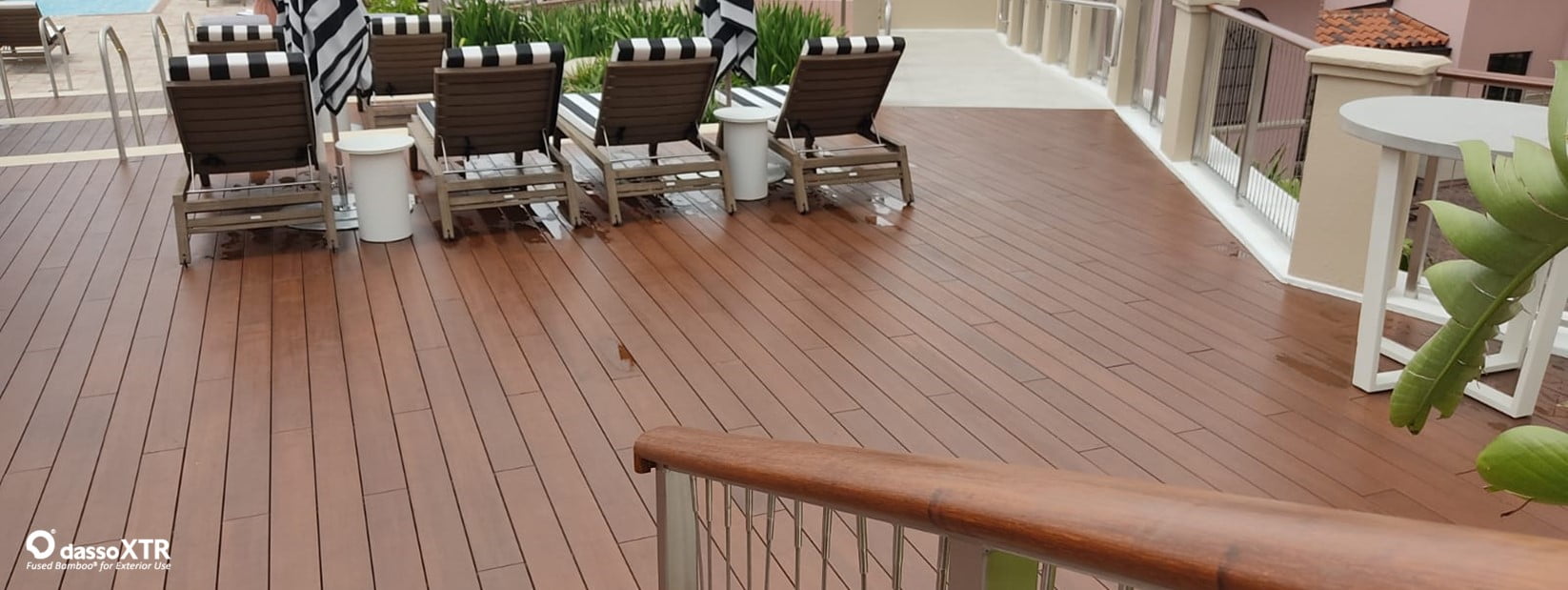
Strand-woven bamboo decking has lower maintenance requirements than conventional wood, all with the authentic natural look of bamboo. The manufacturing process achieves exceptional density that rivals or exceeds that of tropical hardwoods. This density directly translates into very low maintenance requirements.
The material is moisture-resistant, far more than standard lumber, and is less prone to warping, cupping, and rot concerns. Thanks to the density and hardness, there is no splintering or surface damage. Bamboo is naturally resistant to insect damage, requires no chemical treatments, and only needs periodic cleaning with soap and water to remove dirt.
While bamboo benefits from occasional oil application to maintain its color (usually every 1-2 years), this is less of a commitment than the annual sealing and staining required for pressure-treated lumber or cedar. Many owners choose to let bamboo weather naturally to attractive gray tones, effectively creating a low-maintenance look similar to that of tropical hardwoods.
Performance Reality
Bamboo is at a sweet spot regarding maintenance: it requires far less attention than conventional wood and offers the genuine natural material character that synthetic products can’t replicate. The dimensional stability exceeds that of traditional lumber, and properly installed bamboo decking delivers a 20-25-year lifespan with minimal intervention.
The material accommodates both natural weathering and periodic maintenance, giving owners the freedom to choose the approach that suits them. Installation follows conventional hardwood techniques without exotic requirements, but it requires pre-drilling due to the material's density.
Environmental and Economic Value
Bamboo has significant sustainability credentials. As a rapidly renewable grass that reaches harvestable maturity in 3-5 years, rather than the decades it takes for trees, bamboo addresses environmental concerns. The material costs 20-40% less than tropical hardwoods and provides comparable durability and maintenance profiles.
For projects pursuing green building certifications or serving environmentally conscious clients, bamboo is the ideal choice for its documented ecological benefits, including carbon sequestration, soil preservation, and chemical-free cultivation. It combines sustainability, natural aesthetics, reasonable initial investment, and genuinely low maintenance requirements that contractors appreciate.
Ideal Candidates
Bamboo is a practical and flexible choice for different types of projects:
- Residential projects looking for natural materials with low maintenance requirements.
- Commercial installations that must combine durability with environmental credentials.
- Clients looking for sustainability without sacrificing performance.
- Applications that balance initial cost, maintenance requirements, and longevity.
Your Low-Maintenance Deck, Made Simple
The right low-maintenance decking comes down to an honest evaluation of priorities. Capped composites, PVC, and aluminum deliver maximum convenience but sacrifice the natural character that many clients want. Tropical hardwoods offer beauty with surprisingly minimal upkeep, but at a cost that not every project can absorb.
Bamboo sits in a compelling middle ground - natural aesthetics, low maintenance, and a price point that makes it accessible across a wider range of projects than tropical hardwoods. If you're specifying your next deck and want to explore what Dasso's bamboo decking can bring to it, browse our range and get in touch.
Key Takeaways
- Genuinely low-maintenance decking requires only periodic cleaning without sealing, staining, refinishing, or regular repairs.
- Capped composites, PVC decking, and aluminum require essentially nothing beyond occasional cleaning for decades of service. These materials justify their higher initial costs over 25-50-year lifespans, though they sacrifice natural wood aesthetics.
- Tropical hardwoods and bamboo offer genuine wood aesthetics with maintenance requirements far lower than those of conventional lumber. These materials are naturally resistant to moisture, insects, and rot and offer the warmth and beauty that synthetic products can’t replicate.
- UV exposure, moisture levels, temperature fluctuations, and coastal salt air affect all materials differently. Materials that qualify as low maintenance in moderate climates may require additional care in extreme conditions.
- Materials with higher upfront costs often deliver better total value because of lower maintenance expenses and longer replacement intervals. The best approach is to calculate 20-30-year ownership costs, including cleaning, sealing, repairs, and eventual replacement, rather than focusing solely on initial material costs.
FAQs
What is the absolute lowest maintenance decking material available?
Capped composite and PVC decking require the least maintenance, needing only occasional cleaning with soap and water. Aluminum decking is low-maintenance, with the added benefits of non-combustibility and complete moisture resistance. All three don’t need sealing, staining, or refinishing and come with 25-50-year warranties.
Is composite decking really maintenance-free?
No material is truly maintenance-free. Composite decking requires periodic cleaning (usually 2-3 times annually) to remove dirt and debris and prevent mold growth. A composite deck doesn’t need sealing, staining, sanding, and refinishing, something that wood requires annually. Quality composites require much less maintenance than wood, though not zero maintenance.
How does bamboo decking compare to composite decking in terms of maintenance?
Bamboo requires slightly more maintenance than premium composites but significantly less than conventional wood. Bamboo needs periodic cleaning plus optional oiling every 1-2 years to preserve color or can be left to weather naturally to gray tones. Composites need only cleaning. Bamboo has authentic wood character while composites provide maximum convenience. The choice depends on whether natural aesthetics justify additional maintenance.
Do low-maintenance deck materials require any special care?
Most low-maintenance materials require only basic soap-and-water cleaning. Avoid pressure washers on composites and PVC, as excessive pressure can damage surfaces, and use manufacturer-recommended cleaners for stubborn stains. Check that there is proper drainage to prevent standing water and remove debris regularly to prevent mold growth in organic materials. Finally, follow manufacturer guidelines for specific products.
Will low-maintenance decking fade over time?
Fading varies significantly by material and quality. Premium capped composites and PVC products resist fading extremely well, with many manufacturers offering 25-50 year fade warranties. Budget composites may show noticeable fading within 5-10 years, particularly in intense UV environments. Natural materials, including tropical hardwoods and bamboo, weather to gray tones unless periodically treated with UV-protective oils or stains.
Can I reduce maintenance on existing wood decking?
Existing wood decks can't be converted to low-maintenance, but you can reduce ongoing requirements. Apply high-quality penetrating sealers that last 2-3 years rather than annual products and consider semi-transparent stains that require less frequent reapplication than clear sealers. Replace heavily damaged deck boards promptly to prevent rot from spreading and provide proper drainage and ventilation beneath the deck. And whenever possible, replace the deck with genuinely low-maintenance materials for a more cost-effective solution in the long run.
What's the best low-maintenance decking for coastal environments?
Coastal installations need materials with excellent moisture and salt resistance. In this case, aluminum provides absolute corrosion resistance. PVC and capped composites are also beautiful performers in marine environments. Among natural, durable materials, bamboo and tropical hardwoods with high natural oil content resist salt-air damage better than conventional lumber. Avoid uncapped composites and pressure-treated wood in coastal locations.
How much money can I save with low-maintenance decking?
Savings depend on who does the maintenance (DIY vs. professional), material selection, and climate. A typical 300-square-foot wood deck will require approximately $200-400 in materials annually, plus 8-16 hours of labor for cleaning, repairs, and refinishing. Over 25 years, this totals $5,000-10,000 in materials alone, plus 200-400 hours of labor. Low-maintenance materials reduce or eliminate many of these costs, resulting in potential savings of $10,000-20,000 in total ownership expenses despite a higher initial investment.
Avery Chua
Avery Chua has over 30 years of manufacturing and product development in the wood and bamboo-based industry. He has worked across industry mostly in the pioneering stage of production involving MDF, plywood, adhesives and modern coatings. He wears many hats throughout his journey ranging from technologist, quality control, production, R&D, product development and market expansion. His knowledge comes handy in integrating usage of wood, bamboo, adhesives and coatings.