Wood Deck Alternatives
By
Avery Chua
Posted on
Thursday, April 9, 2026 5:53 AM
Wood Deck Alternatives
What You'll Learn
- Why construction professionals are moving away from traditional wood decking
- The key differences between composite, PVC, and bamboo decking
- How to match the right decking material to your project's budget, site conditions, and client expectations
- The total cost of ownership across decking options, beyond the upfront price
Wood Deck: A High-Maintenance Choice
Warm, familiar, and welcoming, traditional wood decking has defined outdoor construction for generations. However, it requires consistent maintenance, which many clients are increasingly unwilling to accept. Staining, sealing, sanding, and the constant battle against mold and rot add up to a lot of frustration.
Any construction professional has to consider both installation costs and long-term performance. If minimal intervention is the main requirement, then wood decking is probably not the right choice. Fortunately, there are many alternatives nowadays, thanks to technological developments and new materials.
Let’s examine alternative decking materials to wood, including composite, PVC, and bamboo, and determine which is right for you. It all depends on your construction project, budget, and client requirements.
Why Professionals Are Moving Away from Traditional Wood Decking
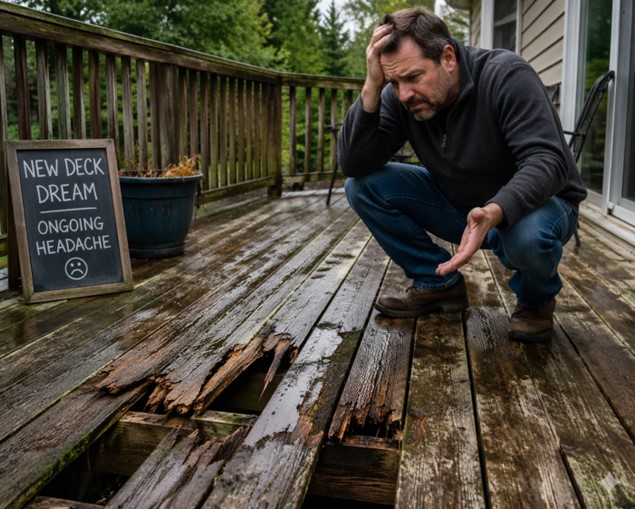 A wood deck has obvious appeal. The natural beauty of real wood, the warmth of the grain, and the connection to traditional materials are hard to replicate. But the gap between the look of natural wood and the reality of owning a wood deck is where many clients start questioning whether it’s the right choice for their project.
High maintenance
Traditional wood decking is inherently high-maintenance. Wood decks can be susceptible to mold and rot, insect damage, warping, and fading, especially in climates with extreme weather conditions. A natural wood deck will require regular staining and sealing to hold its appearance, and even well-maintained wood decks lose ground over time to sun exposure, moisture, and temperature cycling.
Long-term concerns
A deck that requires consistent upkeep reflects on the build, not just the material. In some cases, clients are not fully briefed on maintenance requirements, which can easily leave them unhappy.
The shift toward alternative decking materials is, in large part, a response to that reality.
The good news is that today's decking products have matured to the point where alternatives can satisfy even clients who are firmly attached to the look of natural wood. The best decking materials now available offer the look of wood without its long-term requirements.
The Main Alternatives to Wood Decking
Composite Decking
Composite decking is one of the most popular wood deck alternatives in the industry today, and for good reason.
Made from a blend of plastic and wood fibers, often with recycled materials, composite boards can be produced in a wide range of profiles and finishes. They are designed to address the specific weaknesses of traditional wood decking.
Composite decking is designed to resist fading, staining, mold, rot, and insect damage. It does not require staining or sealing and only requires basic cleaning to maintain its appearance over time. It is also the most practical and affordable choice for clients who want a beautiful outdoor space without the attached maintenance requirements.
Composite decking also holds up well under extreme weather conditions. Where wood decks can be susceptible to moisture infiltration and dimensional movement, composite boards are far more stable. A composite deck handles sun exposure, freeze-thaw cycles, and heavy rainfall better than traditional wood decking, which reduces the need for repairs and refinishing over its lifespan.
The appearance of composite decking has improved dramatically. Modern composite boards are designed to convincingly mimic the appearance of real wood, with realistic grain patterns and a choice of colors and finishes that replicate the look of natural wood species. Professionals opt for composite decking because it delivers a consistent look in large outdoor spaces, something real wood simply cannot.
One consideration worth discussing with clients: composite decking is often hotter than wood under direct sun exposure, which matters around pool decks or south-facing installations. It is a practical point to raise early in the conversation about deck material options.
Composite decking also costs more upfront than pressure-treated lumber. However, when clients compare the higher upfront cost with the low maintenance requirements and long lifespan of a composite deck, the total cost of ownership often favors composite decking. After all, a wood deck will accumulate staining, sealing, and repair costs over the years that a composite deck simply does not.
PVC Decking
PVC decking takes the low-maintenance profile of composite one step further. Whereas composite boards combine plastic and wood fibers, PVC decking is made entirely from cellular PVC. It contains no organic material that can support mold and rot or attract insects.
For professionals building a deck in coastal environments, shaded areas, or areas with consistently high humidity, PVC decking is a serious contender. It requires minimal maintenance over its lifespan, is highly moisture-resistant, and performs well in extreme weather conditions. PVC and composite each solve the wood problem effectively, but PVC decking takes the edge when moisture is the primary concern.
Like composite decking, PVC decking comes in a variety of colors and profiles, designed to mimic the look of traditional wood decking. While it is often more expensive than both wood and composite decking, for the right project, it is the most durable and lowest-maintenance decking material available.
Composite and PVC are often evaluated together, and rightly so. Both are strong alternatives to traditional wood decking, both deliver low maintenance requirements, and both are designed to resist the conditions that degrade natural wood over time. The choice between PVC or composite usually comes down to site context: composite for general use, PVC where moisture resistance is an absolute requirement.
Bamboo Decking
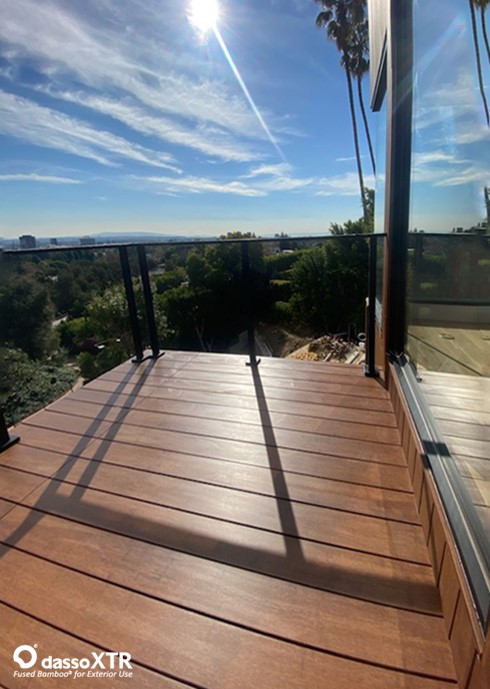
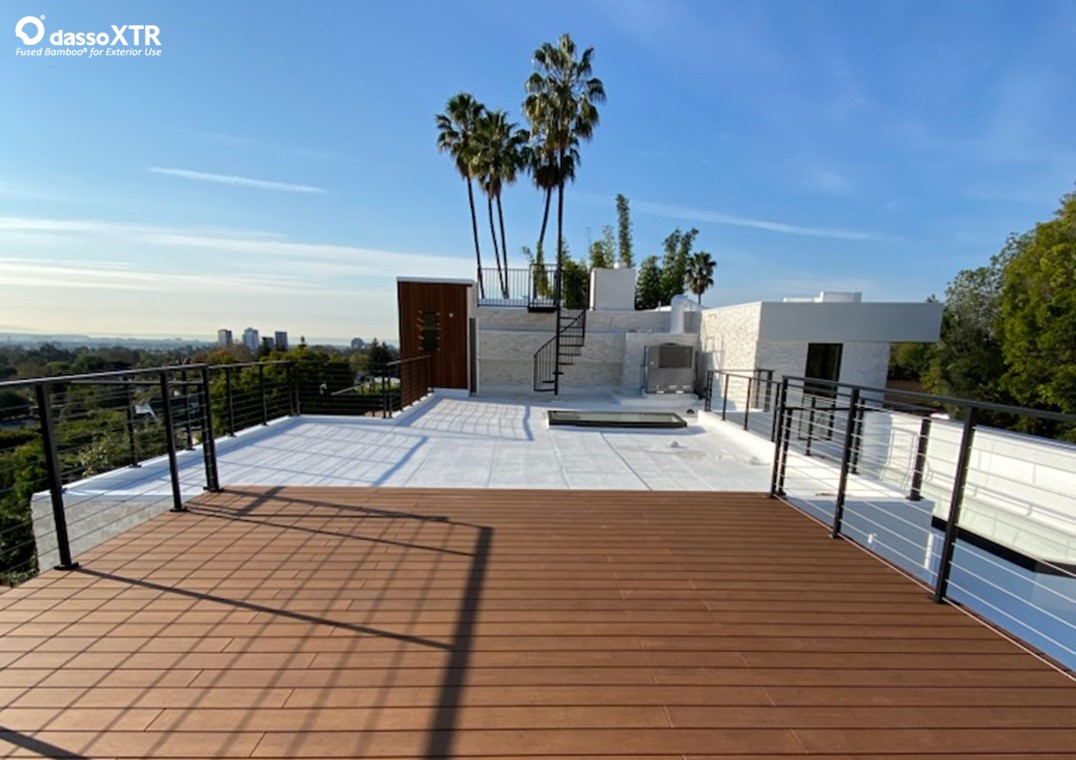
Bamboo decking is the most underspecified option in professional construction, and it’s time to remedy this gap, as it offers something that composite and PVC cannot: the look, feel, and warmth of real wood, with a performance profile that holds up in outdoor conditions.
Bamboo is a grass rather than a timber species, and strand-woven bamboo decking is processed at high heat and pressure to produce deck boards with hardness ratings that rival or exceed those of traditional hardwoods. The result is a decking material that is genuinely durable, resistant to mold and rot, and capable of handling extreme weather conditions better than many expect.
Bamboo decking offers the natural beauty that clients associate with wood decking, such as visible grain, warm tones, and the character of natural wood, without the same maintenance requirements. Decking is often chosen on appearance first, and bamboo competes directly with natural wood on that front, but with much less upkeep. It does not need the regular staining and sealing that a traditional wood deck requires.
From a sustainability standpoint, bamboo is one of the most renewable decking materials available. It matures over years rather than decades, making it more sustainable than tropical hardwoods. If your clients prioritize sustainable sourcing, bamboo decking is an excellent option.
On cost, bamboo decking sits above pressure-treated lumber but is generally competitive with premium composite decking. Compared to exotic hardwoods, it is more accessible. And compared to wood decking over a full maintenance cycle, the value proposition is clear: bamboo decking requires minimal maintenance, maintains its appearance well, and delivers the look of natural wood without the recurring costs of a wood deck.
If your clients are set on the look of natural wood but want a deck that can last without intensive upkeep, bamboo decking is the answer that composite and PVC cannot provide. It is one of the few decking options that sits at the intersection of natural beauty and genuine low-maintenance requirements.
Choose the Right Wood Deck Alternative
Construction professionals must balance budget, site conditions, and client requirements to select the most suitable decking material.
The Budget
Pressure-treated lumber remains the most cost-effective starting point, but clients need to understand the maintenance required over time. Treated lumber is durable and widely available, but it is not a low-maintenance solution.
Maintenance
Composite decking offers the best balance of low maintenance, durability, and cost among engineered options. PVC decking is the step up for maximum moisture resistance.
The look
Do you want a real-wood look? Bamboo decking is the strongest option. It delivers the natural beauty and warmth of wood decking without the maintenance demands of traditional wood decking. High-quality composite boards can also mimic the appearance of natural wood convincingly, but bamboo is the closer match in feel and authenticity.
Environment
Is the project in a high-moisture or coastal environment? PVC decking is highly resistant to moisture-related degradation and requires minimal maintenance, even in demanding conditions.
No single material is the best deck material or best decking material for every project. It depends on the purpose of the outdoor area, the budget, and how much maintenance your clients are willing to deliver. Factors such as upfront costs, available decking materials, site context, and what the client will experience living with the deck over time determine the best decking choice for your project.
Key Takeaways
- Composite decking is low-maintenance, durable, and cost-effective at scale.
- Bamboo decking is the only alternative that delivers the genuine look and feel of natural wood with significantly lower upkeep.
- Traditional wood decking requires ongoing staining, sealing, and repairs - costs that compound over time
- PVC decking is a good choice for coastal or high-humidity environments where moisture resistance is key.
- No single material wins every project. Site context, budget, and client expectations should drive the final decision.
FAQs
What is the best alternative to traditional wood decking for low maintenance?
Bamboo decking delivers the natural beauty and warmth of wood decking without the maintenance demands. It resists fading, mold and rot, staining, and insect damage. Also, it performs well in high-humidity environments at a competitive price.
Is bamboo decking a practical alternative to wood for professional projects?
Yes. Strand-woven bamboo decking is processed under high heat and pressure to produce deck boards with hardness comparable to traditional hardwoods. It resists mold and rot, handles outdoor conditions well, and delivers the natural beauty of real wood without the maintenance that a wood deck demands. It is a strong option for clients who want the look of natural wood without its long-term upkeep.
How does composite decking compare to wood decking over time?
Composite decking is designed to resist the conditions that degrade wood decks, such as moisture, sun exposure, mold and rot, and insect damage. Wood decks can be susceptible to all of these and require regular maintenance to maintain their appearance and structural integrity. Composite decking also reduces that burden significantly, and it’s a more predictable and cost-effective material over the life of the deck.
Is pressure-treated lumber a viable wood deck alternative?
Pressure-treated lumber is not so much an alternative to wood as it is a more affordable decking option. Treated lumber is designed to resist rot and insect damage, and it is a practical option for budget-driven projects. However, pressure-treated wood still requires regular staining and sealing, and it does not deliver the low-maintenance profile of composite, PVC, or bamboo decking.
What should I consider when choosing between composite and PVC decking?
The main considerations are moisture exposure, budget, and aesthetic requirements. PVC decking is the stronger performer in high-humidity and coastal environments, and it requires minimal maintenance over its lifespan. Composite decking is generally more cost-effective and performs well across a wide variety of weather conditions. Both are designed to mimic the appearance of traditional wood decking and offer significant advantages over natural wood, including greater durability and lower maintenance requirements. For most projects, composite is the practical choice; for high-moisture environments, PVC is worth the higher price tag.
Avery Chua
Avery Chua has over 30 years of manufacturing and product development in the wood and bamboo-based industry. He has worked across industry mostly in the pioneering stage of production involving MDF, plywood, adhesives and modern coatings. He wears many hats throughout his journey ranging from technologist, quality control, production, R&D, product development and market expansion. His knowledge comes handy in integrating usage of wood, bamboo, adhesives and coatings.