Cumaru vs Ipe Comparing Two Top Hardwood Decking Options
By
Avery Chua
Posted on
Thursday, July 2, 2026 3:03 AM
When choosing between premium tropical hardwoods for your deck, Cumaru and Ipe are two of the most popular and durable options available. Both offer exceptional strength and longevity, but they have distinct differences in appearance, stability, and cost.
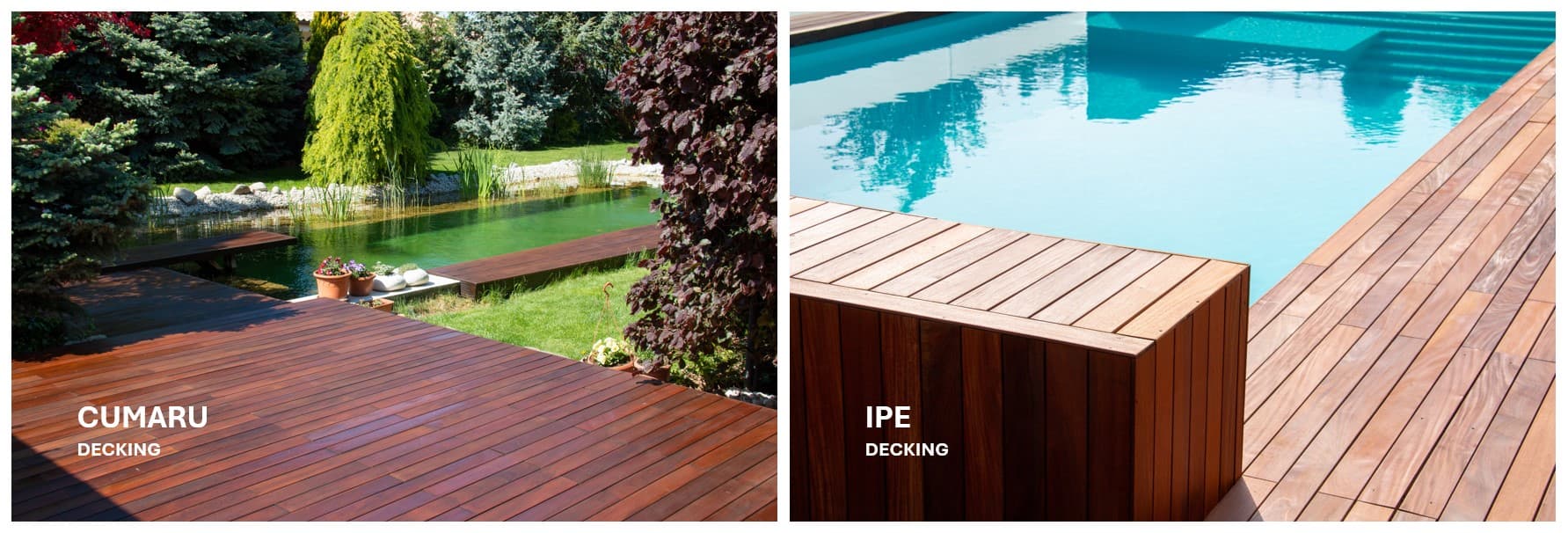
Below is a side-by-side comparison to help you decide which material is the right fit for your project.
Hardwood Decking Comparison: Cumaru vs. Ipe
|
Feature
|
Cumaru (Brazilian Teak)
|
Ipe (Brazilian Walnut)
|
|
Appearance
|
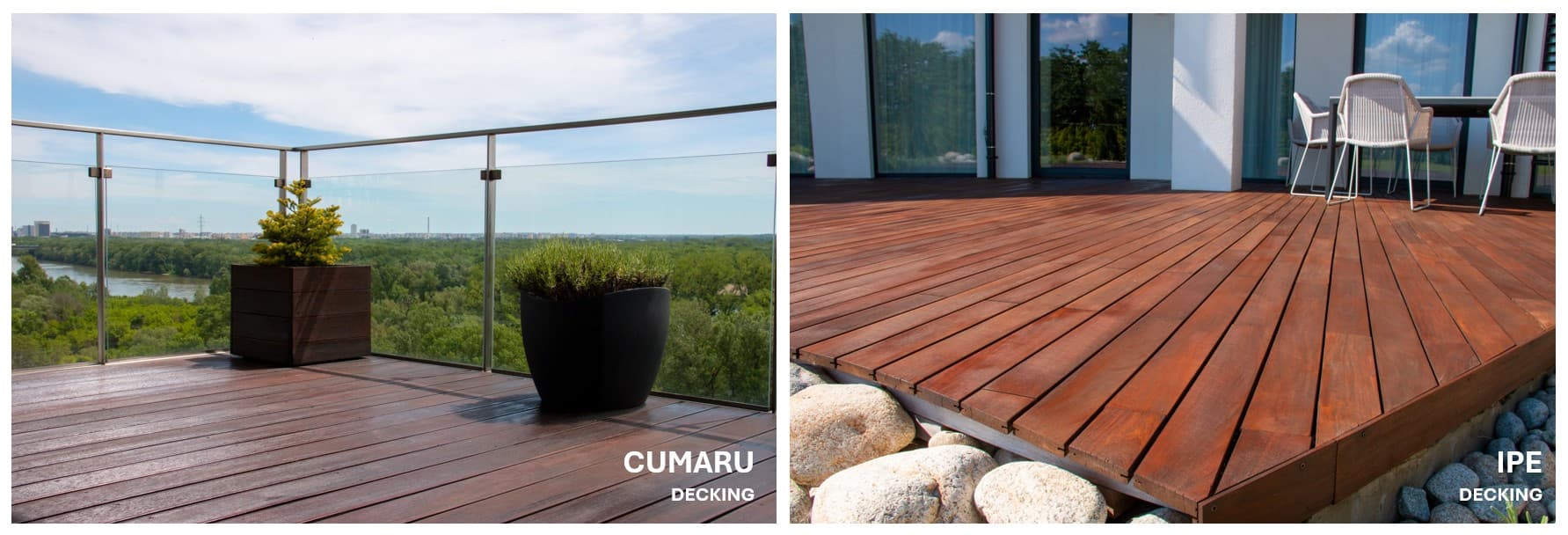
Cumaru is reddish-brown to golden-brown hues; often features a bold, coarse grain pattern.
|
Ipe is Olive-brown to dark chocolate-brown; features a tighter, finer, and more uniform grain.
|
|
Hardness (Janka)
|
~3,540 lbf; extremely hard and dent-resistant. Cumaru is considered hard.
|
~3,680 lbf; slightly harder and often considered the industry standard for durability. Ipe is very hard.
|
|
Stability
|
Naturally robust but requires careful kiln-drying to minimize shrinkage and warping. Cumaru is especially prone to checking and cracking.
|
Exceptionally stable; highly resistant to cupping, twisting, and checking.Ipe could check but far less prone to cracking.
|
|
Durability
|
Cumaru is medium resistant to rot, decay, and insects; excellent for medium-term outdoor use.
|
Ipe - The "gold standard" for longevity; can last up to 75 years with proper maintenance. The tree and its wood, contain a type of natural extrative that acted as natural preservative that kills fungus and hinders insect attack.
|
|
Maintenance
|
Low maintenance; Cumaru can be oiled to retain color or allowed to weather to a silver-gray.
|
Very low maintenance; Ipe is similar to Cumaru, it develops a silver patina if left untreated.
|
|
Cost
|
Generally, Cumaru is more affordable (typically 20–30% less than Ipe).
|
Premium pricing due to its reputation, stability, and extreme longevity.
|
|
Best For
|
Budget-conscious projects that still require high-end durability and a vibrant, warm aesthetic. Do not expect Cumaru to out-last Ipe under the same environment.
|
High-traffic commercial projects or premium residential decks where ultimate longevity is the priority.
|
Key Takeaways
- Ipe vs Cumaru Considerations: Years ago, Ipe was the only widely known choice for luxury decks, but Cumaru can save you significant cost. While Ipe decking is more stable, Cumaru can provide the same hardness and natural looks but for less. Ipe wood remains the favorite for high-end design, but vs Cumaru, the cost-benefit analysis favors Cumaru for many homeowners.
- Final Comparison of Cumaru and Ipe: Whether you select Ipe or Cumaru, you are getting the best decking available. Ipe decking offers a life span of many decades, while Cumaru decking provides a similar look at a lower cost. In the end, the choice between Ipe and Cumaru depends on your specific deck design and budget.
Both woods are exceptionally dense, natural looking and require pre-drilling for installation due to their extreme hardness. Some articles even claim Ipe to be naturally fire-resistant (Class A fire rating), however this is very subjective as Ipe is natural material where two trees grow on different location will show different properties that is significant enough to provide different results. Moreover, Ipe is not a species, but a collection of several species of wood which show few similar characteristics. The natural extractives that acted as natural preservative is different in content, quality and quantity in each tree. This extractives in Ipe play a very crucial role in weather your deck will last for decades or less. Regardless of your choice, ensuring the lumber is responsibly sourced - ideally with FSC certification - is recommended to support sustainable forestry practices.
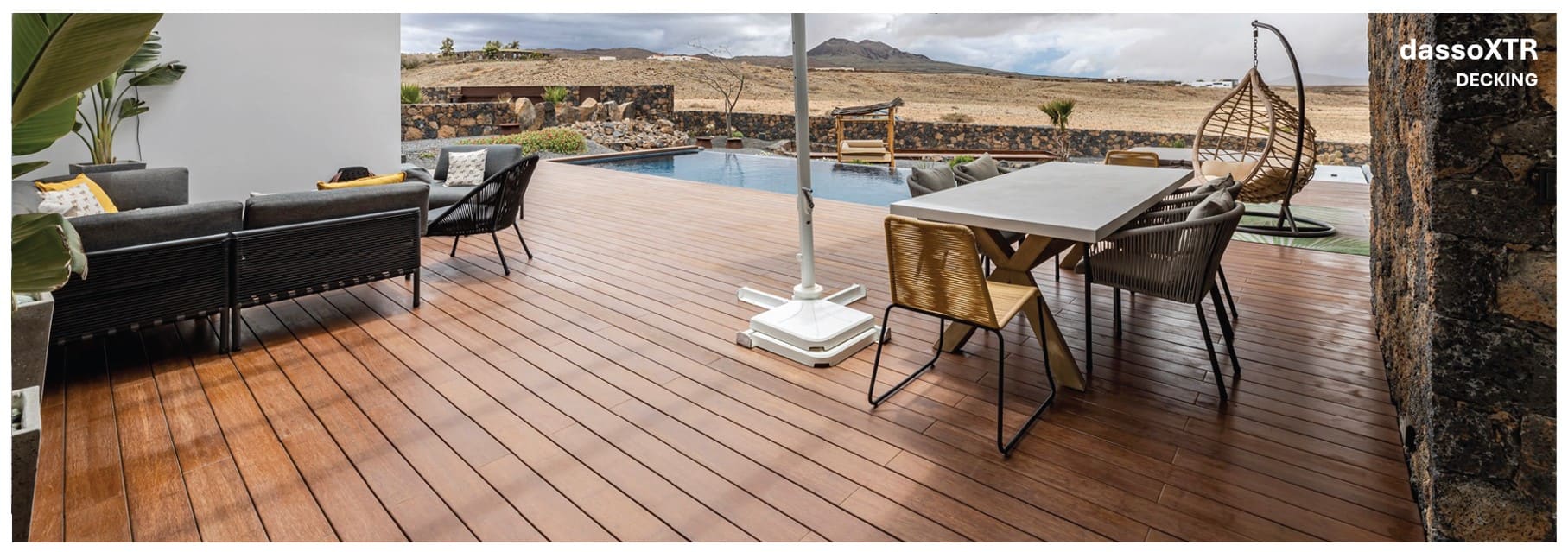
Now, you have a third choice of natural-looking materials that meets all your tropical hardwood requirements but yet is environmentally friendly, sustainable and non-toxic. dassoXTR is superior to Ipe in many ways. The product is fully tested and certified for decking and siding by ICC-ES, Miami-Dade, and CalFire.
Bamboo Decking vs. decking from Ipe or Cumaru
- Enhanced Stability: Bamboo Decking undergoes a patented thermal (Classic version) or crystalize (Epic version) processing that eliminates moisture-attracting sugar and starch. It will not warp, cup, or twist like Ipe and Cumaru natural wood often does.
- Flawless Consistency: Bamboo Decking is completely straigth grain and usually uniform in color, grain, and structural integrity. It is entirely free of knots, sapwood, or natural defects unlike Ipe or Cumaru wood which are both consist of several species of wood group into a single commercial name. Moreover, heartwood and sapwood from a single tree is completely different in properties and colors. As Forrest said, "...is like a box of chocalate, you never know what you are going to get."
- Faster Installation: Bamboo Decking boards feature a tongue-and-groove end-matching system. They lock together seamlessly on the ends, drastically reducing construction time and labor costs. Ipe and Cumaru lumber, even if they are already moulded to Smooth 4 Sides, do not come end-matched.
- Less Waste: You can almost always use nearly 100% of the dassoXTR material shipped. Ipe often requires cutting around natural defects, splits, or severe color variations.
- Lower Pre-Drilling Needs: Side-grooved bamboo decking G2 and G1 profiles accept hidden fastener systems easily. Hard Ipe often demands tedious pre-drilling for every single screw to avoid splitting.
- Eco-Friendly Choice: Bamboo reaches maturity in just 5 to 7 years. Ipe trees take up to 50 to 300 years to mature and cutting them down contribute to climate change due to tropical deforestation.
- Zero Leaching: Bamboo decking does not bleed or leach dark tannins when exposed to rain. Ipe regularly leaches natural extractives that can ruin and stain surrounding concrete or stonework.
- Fully Tested and Certified: Bamboo decking especially dassoXTR had been fully tested and certified by various accredited agency worldwide. In the north american market, dassoXTR is certified for use by ICC-ES, Miami-Dade and CalFire of California. This cannot be said for Ipe nor Cumaru decking planks.
Avery Chua
Avery Chua has over 30 years of manufacturing and product development in the wood and bamboo-based industry. He has worked across industry mostly in the pioneering stage of production involving MDF, plywood, adhesives and modern coatings. He wears many hats throughout his journey ranging from technologist, quality control, production, R&D, product development and market expansion. His knowledge comes handy in integrating usage of wood, bamboo, adhesives and coatings.