Fire-Resistant Building Materials
By
Avery Chua
Posted on
Sunday, October 4, 2026 5:50 PM
Fire-Resistant Building Materials
What You’ll Learn in This Post
- The core fire-resistant building materials specified on commercial and institutional projects, along with the performance characteristics that make each one code-compliant.
- How fused bamboo achieves a Class A ASTM E84 rating.
- Why assembly matters just as much as individual component ratings.
- What to verify before accepting a material substitution and how to balance fire performance with broader design goals.
- Smart specification practices that reduce fire risk on any project.
Fire performance has an unforgiving margin for error. Get the assembly right, and it quietly does its job for the life of the building. But the wrong choice of materials, like an unrated substitution or a finish that doesn't meet the claim on the data sheet, and the consequences can plague a project for years.
That reality is shaping how fire-resistant building materials are being specified in 2026. WUI codes are expanding into jurisdictions that never had them, insurance carriers are pushing back harder on questionable assemblies, and clients are researching how their buildings will perform under real conditions.
The result is a specification environment where fire performance has moved from a code-review afterthought to a front-of-the-process design conversation, even in states that didn’t have such requirements until relatively recently.
A construction manager must have a clear picture of the fire-resistant materials most often specified on commercial and institutional projects. We’ve put together what separates tested performance from marketing language, and where high-performance bamboo from dassoXTR fits into a modern fire-safe building envelope.
Why Fire Performance Belongs at the Top of Every Spec Sheet
Fire safety goes beyond a code checkbox. It’s a design philosophy that shapes structural decisions, envelope detailing, and material selection from the ground up. According to data from the National Fire Protection Association of Fire Analysis and Research, structural failures during fires are overwhelmingly linked to poor material selection or assembly rather than to the fire itself.
For specifiers, that means the materials you choose during design determine how a structure will behave when exposed to heat, flame, and smoke. And with occupant evacuation windows measured in minutes, every material in the assembly matters.
The Core Fire-Resistant Building Materials
Let's walk through the workhorses of fire-resistant construction and the performance characteristics that make them suitable for projects in fire-prone areas.
Concrete and Reinforced Concrete
Concrete is the benchmark for most other fire-resistant materials. Its non-combustible composition, thermal mass, and low thermal conductivity mean it can slow down the spread of fire through a structure.
Reinforced concrete is even better at this. The fire resistance of concrete is well documented: it can maintain structural integrity for two to four hours even in a fully developed fire, depending on cover depth and aggregate composition. For high-rise cores, parking structures, and separation walls, it’s a specifier's default for good reason.
Steel (With Proper Protection)
Steel is a paradox in fire-resistant design. It's non-combustible and offers high tensile strength but loses roughly half its structural capacity at temperatures around 550°C (1,022°F). That's why unprotected metal framing is rarely acceptable in fire-rated assemblies.
Yet, with intumescent coatings, spray-applied fireproofing, or board encasement, it can become one of the most reliable structural materials for fire-rated construction, combining strength, prefabrication efficiency, and predictable performance.
Gypsum Board
Gypsum board (particularly Type X and Type C variants) is the unsung hero of interior fire protection. The chemically bound water in gypsum releases as vapor when heated, absorbing energy and slowing thermal transfer through wall and ceiling assemblies. Standard UL-listed assemblies with multiple layers of Type X can achieve fire-resistance rating designations of one to four hours, which is useful for corridors, shafts, and demising walls.
Cement Board
Cement board has similar non-combustibility to gypsum, with added moisture resistance, making it a good choice for substrates in wet areas, exterior soffits, and cladding backers. Unlike gypsum, it doesn't degrade when saturated and has a longer service life in demanding environments.
Brick and Masonry
Fired clay brick and concrete masonry units are among the most inherently fire-resistant materials available. Load-bearing masonry walls routinely achieve four-hour ratings without supplementary protection, making them perfect for party walls and stairwells.
Ceramic Tiles
Ceramic tiles are often overlooked in fire-resistance conversations because they're categorized as a finish rather than a structural component. And yet, they're one of the most reliable non-combustible surface materials available. Fired at temperatures over 1,200°C during manufacture, ceramic tiles are inherently incombustible and won't contribute fuel load, release toxic smoke, or degrade structurally when exposed to fire.
For commercial kitchens, stairwell finishes, mechanical rooms, and any assembly where you care about surface flame spread, ceramic tile provides a Class A-rated finish. They are durable, easy to clean, and look good over time.
Combined with cement board substrates, tiled assemblies deliver high wall and floor fire-resistance ratings for high-traffic, high-visibility spaces.
Where High-Performance Bamboo Fits In
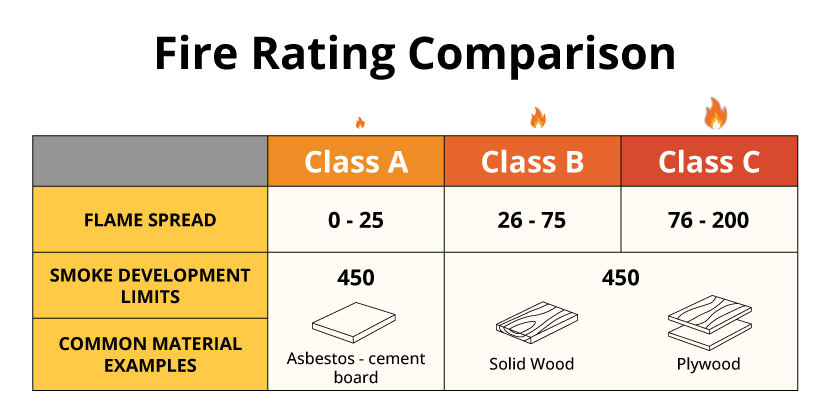
Here's where the conversation gets interesting for specifiers looking beyond traditional options. dasso XTR's engineered bamboo carries a fire-resistant Class A rating (ASTM E84), the same classification as concrete and steel. Its inherent qualities make it one of the few natural-fiber construction materials that can be specified for exterior cladding, decking, and façade applications in fire-sensitive zones.
Bamboo is ideal for projects in wildland-urban interface (WUI) regions, or any construction where non-combustible exterior surfaces are mandated. dasso XTR delivers the aesthetic warmth of tropical hardwood with the fire performance of engineered systems. That's a specification advantage that's difficult to replicate with any other natural material.
Assembly Matters More Than Individual Components
One of the most common oversights in fire-resistant building design is treating fire ratings as a separate concern rather than a part of the whole construction system.
A Class A-rated cladding board installed over a combustible substrate doesn't deliver Class A assembly performance. Likewise, a two-hour rated wall assembly loses its rating with the wrong penetrations.
For specifiers, this means:
- Verify UL or Intertek listings for the assembly, not just individual components.
- Coordinate firestopping details early in the design process.
- Confirm that substitutions carry equivalent assembly ratings.
- Document field verification during construction administration.
Even the best fire-resistant materials in the world will underperform when installed outside their tested assemblies.
Balancing Fire Performance And Broader Design Goals
Modern projects rarely optimize for fire performance alone. Specifiers must also balance energy efficiency, embodied carbon, acoustic performance, and design.
The good news is that fire-resistant materials increasingly deliver on multiple fronts. For example:
- Reinforced concrete contributes thermal mass for passive energy strategies.
- Gypsum assemblies provide noise cancellation, in addition to their excellent fire-rating potential.
- Fused bamboo like dassoXTR is a rapidly renewable material with Class A fire performance. Many construction projects also include mandatory carbon requirements, where bamboo outperforms its competitors.
The specifier's job is to choose materials resistant to fire as well as assemblies that meet fire code, sustainability targets, and design intent.
Reducing Fire Risk Through Smart Specification
Beyond the right selection of materials, the specification process itself can reduce fire risk on any project:
- Prioritize non-combustible materials in exit paths, shafts, and separation walls.
- Detail penetrations, joints, and transitions with tested firestop systems.
- Specify tested and listed assemblies rather than component-level products.
- Coordinate MEP routing to minimize fire barrier penetrations.
- Include commissioning requirements for passive fire protection in the specifications.
None of these are novel concepts, but they're often the difference between a project that performs as designed and one that fails inspection, or worse.
_______________________________________________________________________________________________________________________________________________________________________________________________________________________
Key Takeaways
- Assess fire-resistant building materials at the assembly level, not just the component level.
- Concrete, steel (when protected), gypsum board, cement board, masonry, and ceramic tiles are the main code-compliant fire-rated construction materials.
- Fire resistance performance depends heavily on installation detailing.
- Engineered bamboo from dassoXTR delivers Class A fire performance with sustainability advantages. It’s an extra option for fire-sensitive exterior applications.
_______________________________________________________________________________________________________________________________________________________________________________________________________________________
FAQs
What fire-resistance rating should I specify for exterior cladding in WUI zones?
Requirements vary by jurisdiction, but most WUI codes require exterior wall assemblies to achieve at least a one-hour rating with non-combustible or ignition-resistant cladding. Always verify with the local AHJ and current IWUIC provisions.
How does dassoXTR bamboo achieve Class A fire performance?
The proprietary thermal densification process transforms bamboo fibers into a dense, stable material that performs comparably to hardwood in structure but achieves ASTM E84 Class A flame spread and smoke development ratings when tested as specified.
Is reinforced concrete always the best fire-resistant option for structural applications?
It's often the most straightforward choice for high-rise cores and separation walls, but protected steel, mass timber with encapsulation, and hybrid systems can all meet code requirements. The choice depends on project-specific structural, cost, and design factors.
How do I verify that a substituted material maintains the specified fire rating?
Request the UL or Intertek listing for the proposed substitution's complete assembly, not just a product data sheet. Compare the tested assembly against the originally specified assembly to confirm equivalent performance.
Do fire-resistant materials require special maintenance to preserve their rating?
Passive fire protection generally doesn't degrade under normal conditions, but you should regularly inspect intumescent coatings, firestopping, and door assemblies. Damage, penetrations, and unauthorized modifications are the most common reasons behind loss of ratings.
Can natural materials like bamboo be specified in Type I or Type II construction?
When properly rated and used within their listed assemblies, engineered bamboo products can meet requirements for exterior finishes, decking, and cladding in non-combustible construction types. Confirm code applicability with the AHJ and reference the specific listing documentation.
Avery Chua
Avery Chua has over 30 years of manufacturing and product development in the wood and bamboo-based industry. He has worked across industry mostly in the pioneering stage of production involving MDF, plywood, adhesives and modern coatings. He wears many hats throughout his journey ranging from technologist, quality control, production, R&D, product development and market expansion. His knowledge comes handy in integrating usage of wood, bamboo, adhesives and coatings.