Guide to ASTM E84 Class A Fire Rating
By
Avery Chua
Posted on
Tuesday, August 18, 2026 4:15 AM
ASTM E84 Fire Rating
Each type of building material burns in its own unique way. The ASTM E84 fire rating is the industry-standard test procedure that shows how each one performs. When choosing decking, siding, or other building materials, the ASTM E84 fire rating indicates how the material reacts to fire and whether it slows the spread of flames.
The results are particularly important when comparing various wood or bamboo materials for any type of building project, as some untreated softwoods and lower end composites lack any fire rating.
Knowing these standard measures, what the ASTM E84 fire test entails, and why code officials rely on them will help you make an informed, safety-warranted choice when you pick your exterior building materials.

What Does ASTM E84 Stand For?
Originally, the acronym stood for the American Society for Testing and Materials. However, in 2001, the organization changed its name to ASTM International to reflect its global scope, meaning the letters no longer officially stand for individual words.
The name ASTM E84 now stands for the Standard Test Method for Surface Burning Characteristics of Building Materials. It’s more commonly known as the Steiner Tunnel Test due to the name of the apparatus that runs it. Developed in the 1940’s, it is, even today, the most widely recognized fire test procedure for evaluating a material's behavior when a flame is applied directly to its surface.
The ASTM E84 test results are presented as numerical values indicating flame spread and smoke development rate, rather than a pass/fail evaluation. These numbers are listed in the manufacturer's spec sheets, product data listings, and code submittals. As a recognized fire testing standard, it is well understood by both architects and builders.
Why Does ASTM E84 Matter?
Fire safety and compliance are some of the most important factors in any building or construction project, and surface burning characteristics are among the first considerations during plan check. If a material has a low flame spread performance, it can quickly ignite a rapidly spreading fire along a wall, ceiling, or deck. For this reason, ASTM E84 test results are always included in schools, hospitals, multifamily residential, and single-family residential constructions.
The rating is treated by insurers, code officials, and design teams as the benchmark safety requirement. In areas vulnerable to wildfires, it can even determine whether a building product is legally allowed to be used.
For applications such as exterior decking or siding that are at risk of flame exposure, the ASTM E84 rating plays a key role in planning and construction.
What Is The ASTM E84 Test System?
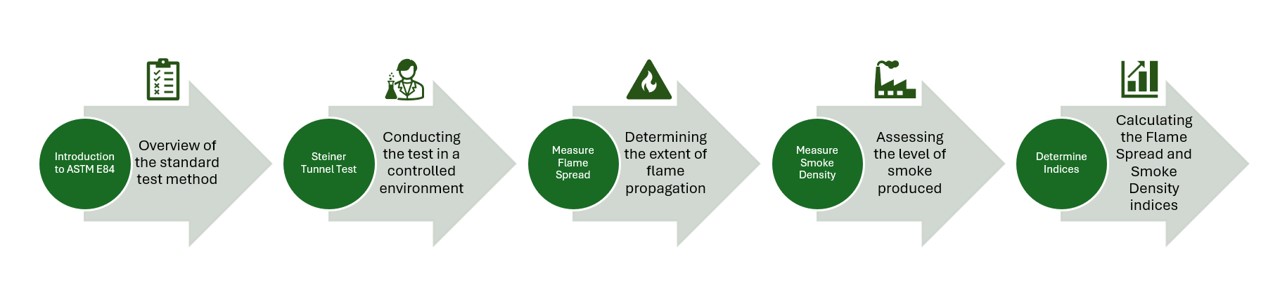
The ASTM E84 test system works as follows: A sample measuring 24 inches by 24 feet is placed inside a horizontal steiner tunnel mounted to the ceiling. Two gas burners are ignited at one end of the sample for 10 minutes while air is forced through the tunnel along with the combustion products.
The length of the flame spread is measured through viewing ports, and photometric equipment measures the amount of light obscured by smoke passing through the exhaust tunnel. The amount of smoke a material produces is continuously measured during each test as well.
The results are calibrated against two reference materials, inorganic cement board and select-grade red oak, which have a flame spread index of zero and one hundred, respectively. These two opposing ends of the spectrum allow testers to compare any type of material under identical fire-exposure conditions to get controlled and accurate test results.
What Are the ASTM E84 Fire classifications?
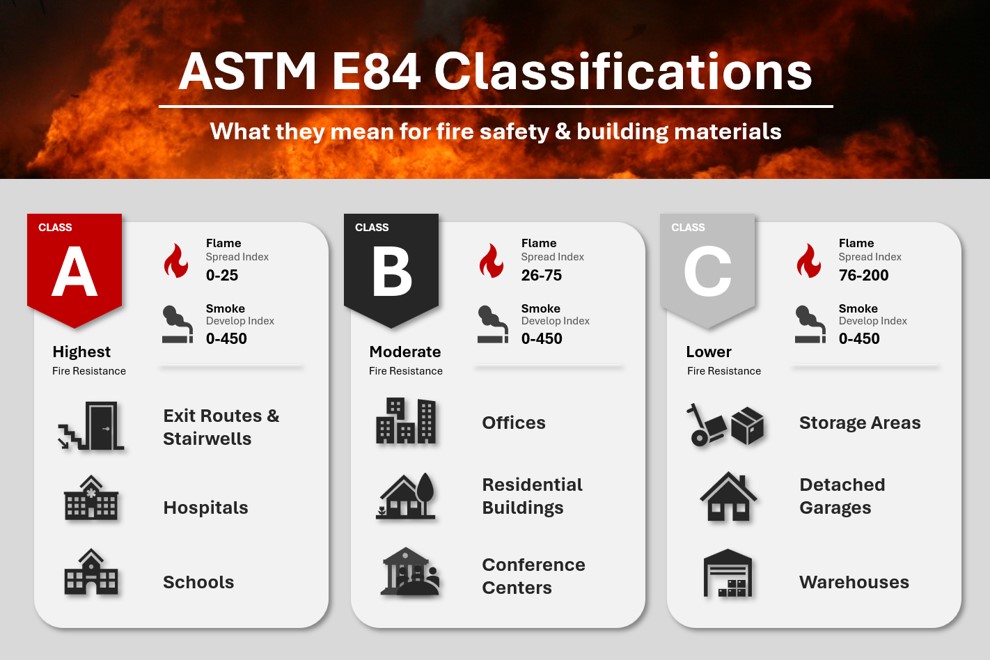
The test results give two sets of data: the flame spread index and the smoke developed index. The combination of these determines the final fire ratings that the materials receive. The first rating, Class A, includes a flame spread index between 0 and 25 and is the highest possible class rating; Class B is between 26 and 75, while Class C is between 76 and 200.
All three classes have the same 450-point ceiling for the smoke developed index. This is so that a material can only obtain a Class A rating if it keeps under this limit, no matter what flame spread score it obtains. Any material that exceeds 200 cannot receive these class ratings and is usually prohibited from interior use.
Because Class A ratings address both spread and smoke performance, they are considered the highest standard for fire-sensitive applications.
How Does ASTM E84 Affect Decking?
As an outdoor fixture, decking is tested to fire testing standards, especially in states with more stringent wildfire regulations. However, some decking materials are not fire-rated, while certain softwoods and brands of PVC and plastic boards have very high flame-spread ratings and are not eligible for Class A fire-rated standards.
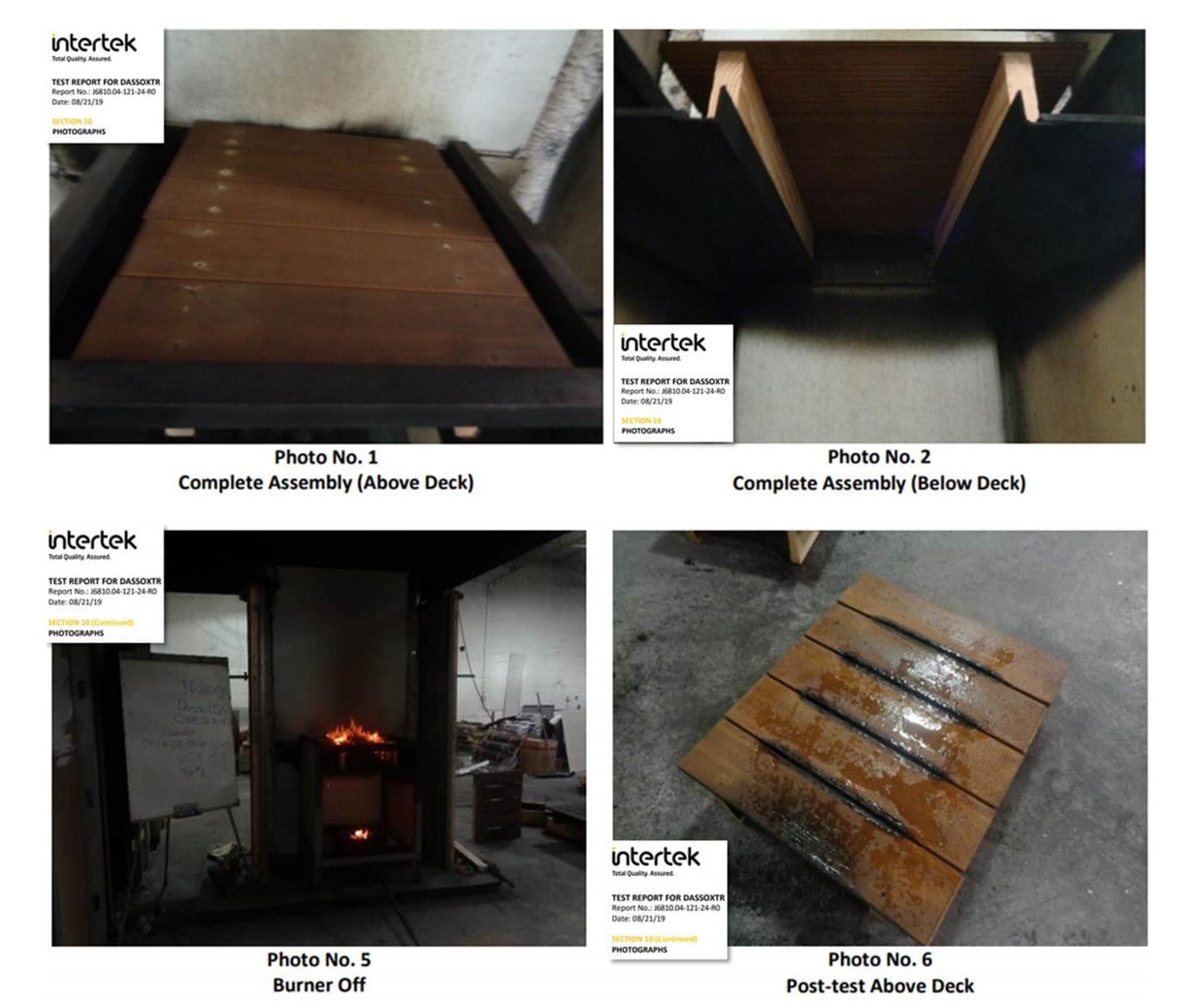
dasso XTR’s fused bamboo decking has a flame spread index of 10 and a smoke developed index of 40, which gives the product a Class A fire rating. This puts it ahead of many wood and composite deck materials. In Wildland-Urban Interface (WUI) areas, a Class A rating can mean the difference between approval and disapproval, as well as serve as proof of code compliance if the application is questioned during permitting.
ASTM E84 Compliance and What it Means
Simply passing the ASTM E84 tests doesn’t necessarily mean that you have passed all of the regulatory requirements. Even so, the ASTM E84 is generally the first piece of compliance evidence that regulatory officials ask for. By meeting this standard, building manufacturers can present third-party laboratory test results rather than making mere marketing claims. This helps speed up the planning and review process and decreases the likelihood of rejection.
Furthermore, passing the ASTM E84 standard helps meet overall fire protection objectives by allowing you to work with materials that have predictable burning properties. If you are choosing materials for exterior building, the presence of ASTM E84 certification is one of the fastest ways to distinguish genuine fire-resistant products from those marketed as such.
One thing to bear in mind when you start to plan for decking or any type of outside building is that the burning characteristics of materials in isolation are not the whole story when it comes to how a product performs with fire once installed as part of decking or a wall. The whole assembly will have its own evaluation, so the structure will have to be tested as such.
Regardless, by choosing full ASTM E84-compliant materials, you are already well on your way to a safe, fire-resistant structure. Both homeowners and contractors alike can then enjoy peace of mind that the construction will meet safety standards. Contact us today to find out more!
Frequently Asked Questions
Is ASTM E84 the same as fire resistance?
No, it is not. The ASTM E84 test examines the surface burning properties, flame spread, and smoke. However, it does not determine the fire resistance of the entire wall or floor assembly, which is assessed separately.
What flame spread index counts as fire safety for decking?
For decking to get a Class A classification, it must have a flame spread index that falls within the range of 0 to 25, and a smoke developed index under 450.
Does a Class A rating mean a material cannot burn?
No, the rating means that the material showed little flame spread and smoke production when tested under certain conditions. However, this does not mean that it will not burn at all.
Who developed the ASTM E84 test?
The ASTM E84 test was tested and developed in 1944 by Al Steiner of Underwriters Laboratories. It is maintained today by ASTM International.
Why do code officials ask for ASTM E84 test results?
Officials need to see a product's ASTM E84 test results, as they are third-party verified and comply with the safety standards cited in the building code, providing a consistent basis for comparing products.
Avery Chua
Avery Chua has over 30 years of manufacturing and product development in the wood and bamboo-based industry. He has worked across industry mostly in the pioneering stage of production involving MDF, plywood, adhesives and modern coatings. He wears many hats throughout his journey ranging from technologist, quality control, production, R&D, product development and market expansion. His knowledge comes handy in integrating usage of wood, bamboo, adhesives and coatings.