Bamboo vs. Ipe: Which Decking Material Wins?
By
Avery Chua
Posted on
Monday, September 21, 2026 4:21 PM
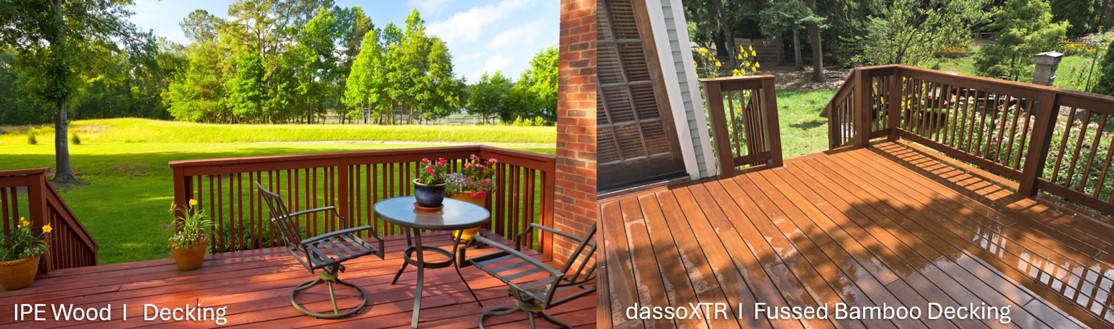
Bamboo vs. Ipe: Which Decking Material Wins?
What You'll Learn in This Post:
- Cost-effectiveness when factoring in warranties, maintenance, labor, and long-term value.
- Sustainability and environmental impact.
- The strengths and weaknesses of Ipe and fused bamboo decking.
- Practical recommendations for contractors.
Ipe has been the default answer for premium decking for a long time, and for good reason. It's dense, it lasts, and clients recognize and appreciate the look. But if you've tried to source it lately, you already know that lead times are unpredictable, chain-of-custody paperwork is getting heavier, and prices keep creeping up.
That’s why many contractors now include engineered fused bamboo as a spec-grade alternative for their construction projects. This is not the flimsy strand-woven material from a few decades ago. Modern, pressure-fused bamboo decking is made of thermally treated boards that match tropical hardwood in hardness, fire performance, and lifespan.
If your projects require quality decking and ipe feels too expensive and difficult to get hold of, fused bamboo is an excellent alternative. Here's how the two materials compare on the metrics that matter when you're pricing a job, scheduling a crew, and standing behind the install five years from now.
Meet the Contenders
Ipe (pronounced "ee-pay") is a category of dense tropical hardwoods harvested from South American rainforests. It's been the gold standard for high-end residential and commercial decks since the 1990s, valued for its density, longevity, and rich chocolate-brown appearance.
Engineered bamboo decking, by contrast, is made from rapidly renewable moso bamboo stalks that are heat-treated, compressed with phenolic resin, and fused into structural boards. The result is a natural composite that behaves like premium hardwood but comes from a plant that regenerates in 5–7 years rather than 60+.
Both materials are marketed as premium options. The question for contractors is which one delivers better performance, better margins, and fewer callbacks over the life of the installation.
Hardness and Durability
This is where the comparison gets interesting.
Ipe decking carries a Janka hardness rating of roughly 3,680 lbf, one of the highest of any commercially available hardwood. Engineered bamboo from dassoXTR pushes that even higher, with a Janka rating around 3,820 lbf, edging out ipe in resistance to denting and surface wear.
On durability ratings, engineered bamboo also holds its own. Products in this category have earned Class 1 (EU350) durability and Class 0 (EU152) fungal ratings, matching or exceeding ipe's Class 1 durability rating. For contractors, this translates to comparable rot resistance, insect resistance, and long-term performance in exposed applications.
Sourcing, Availability, and Lead Times
Ipe's biggest specification challenge isn't performance, because it’s an excellent material for decking projects. The problem is procurement.
CITES restrictions, chain-of-custody documentation, and tightening export controls out of Brazil have made ipe increasingly difficult to source at consistent quality and predictable lead times. Contractors often manage tight construction schedules, where unpredictability is a real cost.
Engineered bamboo is widely available from dassoXTR. Moso bamboo is naturally grown rather than harvested from primary forest, which means supply chains are more stable and material is easier to procure in the quantities commercial projects require.
Installation: Where Contractors Feel the Difference
Ipe's density is a double-edged sword. The same hardness that makes it durable also makes it punishing to work with. It requires pre-drilling for every fastener, carbide-tipped blades, and specialized clips. Boards are heavy and the edges dull tools quickly. This makes installation labor most costly than standard decking.
Fused bamboo is designed with installation efficiency in mind and to make contractors’ lives easier. Boards come with a tongue-and-groove end-matching system that lets crews join boards off-joist. This can cut installation time by up to 30% compared to traditional butt-jointed layouts. Side grooves are milled for hidden fastener systems, so contractors have a cleaner finished surface and there are fewer opportunities for water intrusion at fastener points.
One field note worth passing along: not all bamboo decking boards use identical groove profiles. When specifying hidden fasteners, verify that the clip system is validated for the specific product. dassoXTR publishes fastener compatibility guidance for exactly this reason.
Fire Performance
Both materials perform well here, which is increasingly important as WUI codes expand into new jurisdictions.
Ipe carries a Class A flame spread rating (only heartwood), matching concrete and steel. dassoXTR engineered bamboo also achieves ASTM E84 Class A performance, making it an excellent decking material for fire-sensitive exterior applications where non-combustible or ignition-resistant cladding is required.
Cost and Long-Term Value
Pricing between the two materials has converged. Engineered bamboo decking currently sits at a similar price point to comparable ipe decking with proper chain-of-custody certification. Where the value shifts is in the lifecycle:
- Warranty coverage: Premium engineered bamboo like dassoXTR ships with a 50-year warranty, giving contractors documented backing for client conversations. Ipe carries no manufacturer warranty because it's a raw natural product.
- Installation labor: Bamboo's tongue-and-groove system and easier machining reduce installation costs.
- Maintenance: Both materials weather to silver-gray if left untreated and can be refinished with penetrating oil to restore color. Bamboo's dimensional stability and quality consistency generally means fewer callbacks for cupping, checking or quality inconsistency.
Sustainability and Client-Facing Value
For contractors bidding on projects with LEED, WELL, or other embodied-carbon requirements, bamboo pulls decisively ahead.
Moso bamboo is carbon-neutral across its lifecycle and rapidly renewable, which supports credit pursuits that tropical hardwoods can't achieve. If your client is a municipality, an institutional owner, or a developer with published sustainability commitments, that documentation matters during procurement.
Aesthetics
Ipe has a distinctive look: tight grain, deep brown tones, and a premium presence that clients immediately recognize.
Fused bamboo delivers a similar warm, natural appearance with more consistent color and grain uniformity across boards - no knots. This simplifies installation planning on larger projects where board-to-board variation would otherwise slow down layout decisions. Uniform boards mean less time culling for color match and less waste at the cut station.
Side-by-Side Summary
|
Factor
|
Ipe
|
Engineered Bamboo (dassoXTR)
|
|
Janka hardness
|
~3,680 lbf
|
~3,820 lbf
|
|
Durability rating
|
Class 1
|
Class 1
|
|
Fire rating
|
Class A
|
Class A (ASTM E84)
|
|
Warranty
|
None
|
50 years
|
|
Sourcing
|
CITES-restricted, variable
|
Farmed, stable supply
|
|
Installation method
|
Pre-drill required or additional millwork needed
|
Tongue-and-groove, hidden fastener ready
|
|
Sustainability
|
Concerning
|
Rapidly renewable, carbon-neutral lifecycle
|
|
Cost
|
Comparable
|
Lower than Ipe
|
The Bottom Line for Contractors
Ipe still has a place, particularly on projects where the client specifically requests tropical hardwood and is prepared to accept the sourcing timeline and installation labor that come with it.
For most premium decking projects, however, fused bamboo like dassoXTR delivers a stronger overall package: harder surface, faster installation, backed warranty, easier procurement, and sustainability credentials that increasingly show up in bid documents.
If you're speccing a project where ipe was the default answer, it's worth pricing the bamboo alternative before you finalize the submittal. In most cases, the numbers, the schedule, and the client conversation all get easier!
_______________________________________________________________________________________________________________________________________________________________________________________________________________________
Key Takeaways:
- Ipe’s procurement is hampered by CITES restrictions and unpredictable supply chains, while engineered bamboo offers stable, farmed supply with shorter lead times.
- Bamboo’s tongue-and-groove system and hidden fastener compatibility reduce installation labor by up to 30%, whereas Ipe’s dense boards require pre-drilling and heavy-duty tools.
- Material costs are comparable, but engineered bamboo offers a 50-year warranty, while Ipe lacks manufacturer-backed guarantees.
- Both materials meet Class A fire ratings, making them suitable for WUI zones.
- Unlike Ipe, bamboo is rapidly renewable and carbon-neutral, making it ideal for LEED or WELL projects.
- Both Ipe and fused bamboo deliver a classic, luxurious look with natural grain and rich tones.
- Engineered bamboo edges out Ipe in hardness and matches its Class 1 durability rating, delivering exceptional resistance to wear, rot, and insects.
- Ipe remains a solid choice for specific luxury projects. Engineered bamboo like dassoXTR is the smarter, more sustainable option for most premium decking jobs.
_______________________________________________________________________________________________________________________________________________________________________________________________________________________
FAQs
Is engineered bamboo as hard as ipe?
Actually, by most measurements it's harder. dassoXTR carries a Janka hardness rating of approximately 3,820 lbf compared to ipe's 3,680 lbf. In real-world terms, both materials resist denting from dropped tools, furniture legs, and heavy foot traffic at levels well above domestic hardwoods like oak or maple.
How does the installation cost compare between the two materials?
Material pricing is comparable, but installation costs usually favor bamboo. Ipe requires pre-drilling every fastener, dulls blades quickly, and needs specialized clips. Engineered bamboo ships with tongue-and-groove ends and side grooves milled for hidden fasteners, which can trim installation time by up to 30% on larger projects. Fewer labor hours add up over the course of a project.
Do I need to worry about warranty claims with bamboo?
Engineered bamboo from dassoXTR comes with a 50-year residential warranty (10-year commercial), which is backed documentation you can pass along to the client. Ipe has no manufacturer warranty because it's a raw natural material, so any performance claim falls back on the installer.
Will the color hold up over time?
Both materials weather to a silver-gray patina if left untreated. If the client wants to preserve the original brown tone, a penetrating oil finish applied every one to three years does the job for either material. Bamboo's more uniform grain often makes recoating easier and more predictable across the deck surface.
Can bamboo decking be used in wildland-urban interface zones?
Yes. dassoXTR carries an ASTM E84 Class A flame spread rating, which meets the ignition-resistant material requirements in most WUI jurisdictions. Always verify the specific listing against the local AHJ's adopted code before finalizing the spec.
Is bamboo a good choice for coastal or waterfront projects?
Coastal projects are one of the strongest applications for engineered bamboo. The thermal and crystalized densification process makes the boards non-porous, so they resist saltwater, marine borers, and fungal decay comparably to ipe. For dock and boardwalk installations, pair the boards with 316 stainless hardware for a fully corrosion-resistant assembly.
What's the lead time difference between the two materials?
This varies by supplier and region, but Ipe lead times have gotten longer and less predictable as CITES enforcement has tightened. Engineered bamboo is available on more consistent schedules because supply comes from managed farms rather than regulated forest harvest. For projects on tight construction timelines, engineered bamboo is the safest choice.
Avery Chua
Avery Chua has over 30 years of manufacturing and product development in the wood and bamboo-based industry. He has worked across industry mostly in the pioneering stage of production involving MDF, plywood, adhesives and modern coatings. He wears many hats throughout his journey ranging from technologist, quality control, production, R&D, product development and market expansion. His knowledge comes handy in integrating usage of wood, bamboo, adhesives and coatings.